

2026 Updated Entrance fees for Ngorongoro Conservation Area
Ngorongoro Conservation Area Fees
2026 Updated Entrance Fees for Ngorongoro Conservation Area: Tanzania, a country where you will really enjoy the beauty of Mother Nature and all the breathtaking attractions. This beautiful country has a lot to offer to every sense organ of its visitors, from the views of the outstanding plains of the incredible Serengeti and the jaws of the great Ngorongoro Crater, yes, the masterpiece of the Ngorongoro Conservation Area, to the melodies of the bird singers and sweet vernacular languages from famous tribes like the Maasai.
On your Tanzania wildlife Safari, you won’t hesitate to visit the world’s largest unbroken caldera, the Ngorongoro Crater, a part of the Ngorongoro Conservation Area. Ngorongoro Crater is the largest intact caldera in the world, which is said to have been formed about two to three million years ago after a large active volcanic eruption.
This caldera is about 20 kilometers across, 600 meters deep, and 300 square kilometers in area, a stunning crater with a high density of wildlife in Africa. Ngorongoro Conservation Area was separated from Serengeti National Park in 1959. UNESCO declared it a World Heritage Site in 1979. Ngorongoro Conservation Area is located about 120 kilometers west of Arusha, accessible by all major means of transport, i.e., by air, railway, and road.
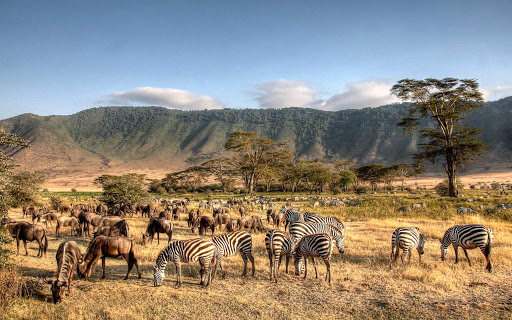
Ngorongoro Conservation Area is home to uncountable attractions, starting from the Big Five, Lake Magadi, Ngorongoro Crater, outstanding wildlife residing on the crater floor, and amazing colorful birds, to name a few. Those are just some of the attractive things found in the Ngorongoro Conservation Area.
This wonderful place is bordered by other breathtaking destinations, including Lake Natron, Olduvai Gorge, Maasai Village, the Shifting Sands, Olmoti and Empakai Crater, and the Gol Mountains. You have every reason to visit this historical piece of land inside the Serengeti Ecosystem.

Planning a trip to Ngorongoro Conservation Area is very simple; you can do it using your fingertips using a mobile application or website. Just pick the best tour operator and plan your trip with them, and get ready to be astonished by the wonders that Ngorongoro will display to you.
You must be updated on the entrance fees, which you will be charged during your stay at Ngorongoro Conservation Area, one of the Seven Natural Wonders of Africa. Entrance fees are charges that visitors pay during a Tanzania wildlife Safari. Entrance fees charged in the Ngorongoro Conservation Area are as indicated below:
Entrance fee: East African citizens and Tanzanian citizens of or above the age of 16 years are charged a conservation fee of 11,800 Tanzanian Shillings, while children aged between 5 and 15 years are charged a conservation fee of 2360 Tanzania Shillings. Children below 5 years are not charged entrance fees for safaris in the Ngorongoro Conservation Area.
Non-East African citizens are charged an entrance fee of 70.8 USD for those above the age of 16 years, while an entrance fee for children aged between 5 and 15 years is 23.6 USD, and children below 5 years are not charged.
Residents or expatriates of or above the age of 16 years are charged an entrance fee of 35.4 USD, while children aged between 5 and 15 years are charged an entrance fee of 11.8 USD and children below 5 years are not charged anything.
Note that entrance fees are payable per entry per head and are valid for 24 hours. Entry permits issued are valid for one entry, a half-day experience at Ngorongoro Crater.
Other charges include crater fee, camping fee,
Crater fee: This fee is paid per vehicle. For East African citizens and Tanzanian citizens, the crater fee is 11,800 Tanzania Shillings per vehicle, while non-East African citizens are charged a crater fee of 295 USD.
Walking safari guide fee: You may probably be interested in taking a short or long walk in the Ngorongoro Crater. The fee for a walking safari is 23.6 USD for non-East African citizens of 16 years or above, and children aged between 5 and 15 years are charged a fee of 11.8 USD. For East African citizens, the fee is 11,800 Tanzanian shillings for those above 16 years and 5,900 Tanzanian shillings for children aged between 5 and 15 years.
You should be informed that the fees for walking Tanzania safaris vary depending on the time spent. Short walks take 1 to 4 hours, while long walks take more than 4 hours.
Camping fees: Camping in one of the world’s most spectacular places is a once-in-a-lifetime experience. You will experience incredible sleep in the African jungle. The camping fees for non-East African citizens of or above the age of 16 years are 35.4 USD, while the fee for children aged between 5 and 15 years is 11.8 USD.
Tanzanians and East African citizens are charged a fee of 11,800 Tanzanian shillings for those above 16 years and 5,900 Tanzanian shillings for children aged between 5 and 15 years.
Special campsite fees: Ngorongoro Conservation Area has state-of-the-art special campsites for you during your trip. You may have your own camping gear or your tour operator will provide it. The fee for a special campsite is payable per person per night, and prior booking is required.
The fee for Non East Africans of or above the age of 16 years is 70.8 USD and 35.4 USD for children aged between 5 and 15 years. Tanzanians and East African citizens of or above the age of 16 years are charged a 17,000 Tanzanian shillings fee and 8,850 Tanzanian shillings for children aged between 5 and 15 years.
Hotel concession fees: These fees are payable per person per night for every visitor staying in the lodges, hotels and tented camps. East African citizens and Tanzanian citizens of or above the age of 16 years are charged a fee of 35,400 Tanzanian shillings, while those aged between 5 and 15 years are charged a fee of 11,800 Tanzanian shillings.
Non-East African citizens of or above the age of 16 years are charged a fee of 59 USD, while children aged between 5 and 15 years are charged a fee of 11.8 USD.
Fee for visiting Olduvai Gorge: Ngorongoro Crater is neighbored by other spectacular attractions where you can refresh after getting used to viewing animals. Olduvai Gorge is one of those places where you can learn a lot about the remains of our ancestors.
The fee for East African and Tanzanian citizens of or above the age of 16 years is 5,900 Tanzanian shillings, but for children aged between 5 and 15 years, the fee is 1,180 Tanzanian shillings. The fee for non-East African citizens of or above the age of 16 years is 35.4 USD, while the fee for children aged between 5 and 15 years is 11.8 USD. Apart from Olduvai Gorge, other attractions neighboring the Ngorongoro Crater are Olmoti Crater, the Laetoli footprints, Ol Donyo Lengai, and Lake Natron.
Payment Procedures and Guidelines
Ngorongoro Conservation Area categorizes its visitors on the basis of their citizenship. Non-East African citizens are tourists from any country in the world that is not a member of the East African Community. They are sometimes referred to as foreign non-residents.
Expatriates are tourists who are currently living in the United Republic of Tanzania under a valid visa. They are not citizens of Tanzania. They may be students studying in Tanzania, businessmen, and other people with a valid visa. They are also called foreign residents.
East African citizens are visitors coming from member states of the East African Community, including Tanzania, Kenya, Uganda, Burundi, Rwanda and South Sudan.
Visitors are required to produce their valid national ID or a passport at the entry gate. Expatriates must have either of the following documents: resident’s permit (Class A, B or C; exemption certificate; temporary pass attached with Government receipt including acknowledgement letter; and Diplomatic passport or ID.
Ngorongoro Conservation Area has simplified the mode of payment by issuing smart cards called Ngorongoro cards. These cards are issued after you have paid or when you provide relevant paying slips for a service you want. You can make payment using banks, VISA, and MasterCard.
Ngorongoro cards are issued from various points, including the Ngorongoro Conservation Area Authority office or the Arusha Information Center located near the Tanzania Tourism Board office in Arusha. You can also get an Ngorongoro card at the Lodoare gate, the main entrance gate, and from headquarters. Visitors from the Serengeti can get Ngorongoro cards at the Nabbi gate.

Cards issued include citizen cards for East African citizens, resident cards for Tanzanians, and non-resident cards for non-residents. Other cards include tour operator cards, annual vehicle cards, staff cards, concession cards, and annual personal cards, and the 2022 Updated Entrance fees for the Ngorongoro Conservation Area.
You should be informed that all charges are exclusive of VAT. The fee is non-refundable. Conservation and Vehicle fees are for multiple entry. Concession fees are paid up front.
Many travelers dream of visiting the spectacular Ngorongoro Conservation Area. Things have been made simpler now; you can get a trip ticket to Tanzania from anywhere in the world. This means that travel is not a restriction anymore.
You can book a trip to Ngorongoro Crater using a mobile application or by email inquiries. Most tour operators have 24/7 customer service; feel free to ask anything about trips and safaris. After you have planned your trip, all I can say is Welcome to Tanzania; Karibuni Sana Tanzania.

