
Attractions in Ngorongoro Conservation Area
Attractions in Ngorongoro Conservation Area are widely spread both inside the crater and throughout the entire conservation area, as well as in nearby attractions. Ngorongoro conservation Area is part of the great Serengeti National park ecosystem that hosts annual wildebeest migration, which occurs in the Southern Serengeti national park and in the Northern part of Ngorongoro Ndutu area
Initially, the Ngorongoro Crater, Lake Manyara, and Tarangire National Parks were all part of Serengeti National Park before being separated due to local community settlements in the corridors where animals could move freely depending on the season.
The attractions in Ngorongoro are transverse and cross across the entire conservation to the furthest Olduvai Gorge, where the remains of the old man were discovered by Dr Leacky. Below are the key attractions of the Ngorongoro:
WILDLIFE
The Ngorongoro Crater is home to the big four, with leopards being rare or not seen, while other animals like the rare black rhinos, buffalos, elephants, and lions are easy to spot during your game drive in the crater. Other animals seen are different species of Antelopes, Zebras, Warthogs, Wildebeests, Jackals, and others.
The Crater Lake attracts many animals that come to the area for water, while the nearby swamp provides a cool environment for elephants and cape buffaloes; these animals can often be found, especially during the dry season, cooling themselves in the muddy area. The swamp also features hippo pools where large schools of hippos are frequently spotted.
BIRD SPECIES
Birds are one of the greatest attractions in Ngorongoro; at one time, it was referred to as the birders’ paradise in Tanzania, hosting both permanent and migratory birds from Asia and Europe that typically arrive from September to April, which is the rainy season for breeding, including the European Swallows, Caspian Lapwing, European Rollers, and Montagu’s Harrier, to mention a few.
Other big ground birds are ostriches, grey-crowned cranes, secretary birds, Kori Bustards, and many more. The soda lakes of Ngorongoro are the breeding grounds of thousands of flamingos and other water birds, such as ducks, waders, and herons.
NGORONGORO CRATER
The Ngorongoro Crater is one of the key attractions of the Ngorongoro conservation area with its unique view, being the largest caldera with a ground size of 264 square kilometers. Before descending into the crater, guests always enjoy a great view from the crater viewing point, which is located just a few kilometers away from the main gate. It gives you a spectacular view of the crater, with the animals at the top looking like dotted trees.
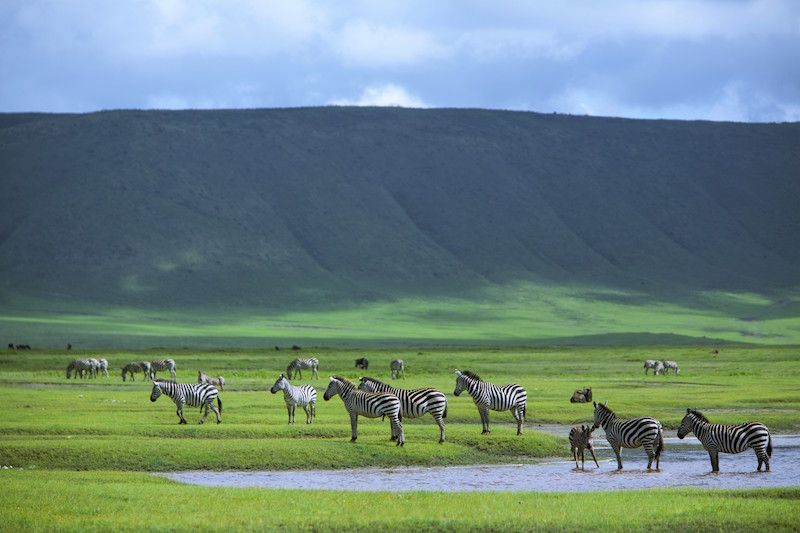
The crater has soda lakes that attract more bird species especially the flamingos and other water birds, and Lereal Forest, which gives a picnic view site and also a hiding point for the predators and shelter for some of the birds.
GOL MOUNTAINS
The Gol Mountains, also known as the Mountains of the Gods, are revered and feared by the Maasai people, who hold a deep cultural attachment to this mountain. The Gol Mountains are located in the remote area of Ngorongoro on its northwest within the conservation area. This remains one of the most traditional corners of Tanzania, home to Maasai who still kill lions as their rite of passage into warriorhood and who still live outside cash society.
OLDUPAI MUSEUM
The Oldupai Museum is a small museum located on the rim of Oldupai Gorge, one of the most significant archaeological sites in the entire world. It was discovered by Dr. Leakey. He discovered the remains of the early man at this site in 1959. This site can be visited during a safari to Ngorongoro or while traveling from Serengeti back to Ngorongoro, as it is located along the route and offers views of other animals on the way to the Museum.
LAETOLI
Located in the Southern part of Oldupai Gorge deep in the remote areas, Laetoli is renowned for its footprint remains, which are not clear exactly whose footprints they are, though many believe that they were for the Australopithecus afarensis.
