

A Road Trip to Ngorongoro Conservation Area
A Road Trip to Ngorongoro Conservation Area : During holidays when many people are competing for mysterious tourist destinations, you may be confused on where to go for adventurous safari. I have a best option for you, Tanzania.
This fabulous country is home to uncountable breathtaking destinations where you will never compete for. Tanzania Safari tours and adventures, climbing and other activities are commonly done in Tanzania. Some spectacular destinations in Tanzania include Serengeti National Park, the home of the Great Migration, Mount Kilimanjaro, the highest peak in Africa and Ngorongoro Conservation Area, the home of the world’s largest intact caldera. This country is home to 22 national parks, 22 game reserves and 1 conservation area. All these attractions make Tanzania a must-go destination for every safari-goer.
If your first choice is Ngorongoro Conservation Area congrats for being such luckier. Here you will explore nature, wildlife and culture. A road trip to Ngorongoro will leave with unexplainable stories in your mind because you will interact with stunning wildlife, natural wonders and cultural practices in the wilderness. A ride through the Ngorongoro Conservation Area will make you interact with the following exotic attractions;
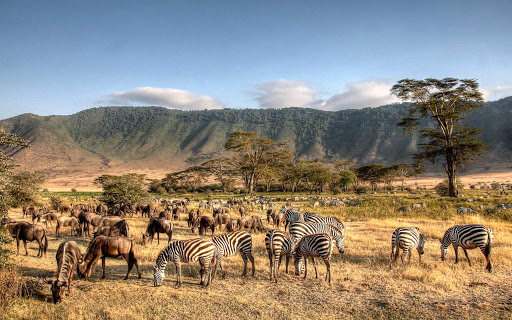
The Ngorongoro Crater, yes this is the largest intact caldera in the world. This caldera is 20 kilometers across, 600 meters deep and 300 square kilometers in area. It was formed after the collapse and eruption of the Ngorongoro Mountains. Ngorongoro Mountains was the tallest mountain in the world before it erupted and collapsed. The gigantic volcanic eruptions led to the formation of a large unbroken caldera, one of the Seven Wonders of Africa. Your ride will let you witness how the sunrise and sunset appear when you are in this breathtaking caldera. You will stop in the edge of the crater rim and hike through the rim with your binoculars for viewing scenic views of vegetation, birds and wildlife, A Road Trip to Ngorongoro Conservation Area
The Big Five. Ngorongoro Conservation Area is the second guaranteed destination from Serengeti National Park for sightseeing the majestic Big Five animals. The word “Big Five” doesn’t mean that these animals are largest, it means they pose high threat to their predators. They include lion, leopard, Cape buffalo, African elephant and the black rhino. Ngorongoro Crater has everything that may be required by these animals. On your ride, you will stop here and there to witness huge groups of Cape buffalos grazing or drinking water. You can’t skip the captures of leopard’s excellent kills when crosses nearby. The world’s largest land animals are usually spotted in woodlands, grassland plains and in short shrubs. You may ask your tour guide for a perfect photo with a background of elephants. That will be gorgeous. Here and there in the crater floor, you will view the “King of Jungle”, lion resting on the short grasslands or doing its excellent hunts. Your road trip will meet you with the world’s endangered species, the black rhino. The population of this historical mammal has declined from decade to decade. It is very rarely seen in other national parks apart from Serengeti and Ngorongoro. Therefore, it is your chance to enjoy the natural beauty of this animal. The black rhino isn’t a social animal, so you will find it in places with little interactions and noises. It is commonly spotted in shrubs in group of three to four. Your road trip will be awesome after seeing different Big Five animals.
The wildlife. Apart from the Big Five animals, Ngorongoro Crater is home to stunning wild animals that will make your safari an incomparable one. Some of these animals include wildebeests, hartebeests, zebras, gazelles, warthogs, cheetahs, striped and spotted hyenas, black jackals, giraffes, foxes, eland, antelopes, bushbucks, waterbucks, impalas, reedbucks and wild dogs. The crater has pastures and water sources which make wild animals non-migratory contrary to the likes of the Serengeti. Some migratory animals like zebras, wildebeests and gazelles enter this crater during the Great Migration. Your road trip will come stop for almost an hour if large group of wildebeests, zebras and buffalos block your way on their way to the water sources. You will have an opportunity to take pictures and videos (if you have a permit). The young ones of the wildebeests and zebras are beautiful with colorful skin. If you are luckier, you will witness the splendid hunting techniques of the world’s fastest land animal, cheetah. Cheetah hunt by distracting a large group of prey and choosing its best prey. After selecting a prey, it starts running fast past other animals to capture. Most of cheetah’s hunts are successfully due to its excellent technique. You will also stop after hearing the voices of the aggressive hyenas scrambling for food remains. These animals are lazy predators. They usually consume bone remains left by successful predators like lions, leopards, wild dogs and cheetahs, A Road Trip to Ngorongoro Conservation Area .
Lake Magadi. This is a soda lake found in the crater floor. The name “Magadi” is a Maasai word for salt. You will ride to this lake to witness the large crowds of pink flamingos. If you have visited Lake Manyara and Lake Natron recently pink flamingos are the birds, you saw on the shallow shores of the lakes. If your question is “why pink flamingos on soda lakes?” I have an answer for you. Soda or alkaline lakes are homes to blue-green spirulina algae which are favorite food for pink flamingos. However, water sports like swimming, snorkeling and boat safaris aren’t permitted here, because Lake Magadi is a significant water source for thousands of wild animals.

The birds. You will have numerous stops for viewing colorful birds flying over your van. Binoculars will give you bright visions. Some bird species which you will encounter in the Ngorongoro Crater are black kite, lesser flamingo, grey crowned crane, Kori bustard, Black-winged lapwing, living turaco, Egyptian vulture, Verreauxs eagle, Hildebrandt’s spurfowl, ostrich, White-eyed slaty flycatcher, secretary bird, African spoonbill, Red and yellow barbet, Jacksons widowbird, Hartlaubs turaco, Namaqua dove Rufous-tailed weaver, Rosy-throated long claw and many others.
Lerai Fever Tree Forest. A road trip inside the crater floor will meet with one of the rare forest found in the Ngorongoro Crater. It is made of yellow-barked acacia trees. Common animals which can encountered in this forest include elephants eating tree branches, black rhino grazing in shrubs, eland, hyrax, bushbuck and birds. This forest has seasonal and permanent swamps which attract large herds of elephants, buffalos, antelopes and many others seeking water to cool their thirsty after grazing for a long time. Predators like lions, hyenas, leopards, wild dogs and cheetahs never leave their prey faraway, you will spot them in this forest looking for an easy meal, A Road Trip to Ngorongoro Conservation Area .
The Olduvai Gorge. Your road trip won’t be perfect without reaching this incredible place. It is found in the Ngorongoro Conservation Area out of the Ngorongoro Crater. Olduvai Gorge is an archaeological or historical site where the ancient skull of human beings was discovered. The Leakeys dug the bones and skull which dates back to 2 million years ago. The Leakeys also found the hunting weapons dating back to 1.5 million years ago. Another place close to Olduvai Gorge is Laetolli where the footprints of a man, women and child were discovered. You will stop there for an hour visiting these sites and museum where you will be detailed with everything you need to know at Olduvai Gorge. You will be part of few people to know much about the history of man by viewing the tools used about 2 million years ago.
The Shifting Sands. Yes, an area with observable sand movement found outside the crater is worth a visit. You will drive to this mysterious place to witness wonders of this sand. The sand moves at a rate of 15 meters per year. It is a dune of moving sand with a length of up to 5 hundreds and 9 meters thick. This is excellent place for you to observe this natural wonder.

Gol Mountains. From the crater your road trip will head in the northwest direction where you will encounter the Gol Mountains. The Maasai connect these mountain ranges with their spiritual belief that God exist there. They call them as “the Mountains of God” and they worship them.
Olmoti Crater and Empakai Crater. After seeing the world’s largest unbroken caldera, you can drive to other calderas which were formed during the same volcanic eruptions. Your road trip will stop at Olmoti crater, a shallow, grassy, hollow crater where the Munge stream emerge and flows into the Ngorongoro Crater to feed Lake Magadi. The Maasai feed their cattle there. Within this grassy crater, you will spot eland, bushbuck and reedbuck. You will also drive to the Empakai crater, crater that is occupied by a soda lake. On its rims, you can see the views of the distant Mount Kilimanjaro.
Honestly, I can’t summarize all the views which you will experience during your road trip to Ngorongoro Conservation Area. Booking a road trip to Ngorongoro is easy, you can do it online before arriving to Tanzania or you can book it after your arrival. Good luck!

